alan@alanshires.co.uk
  • Home
  • Voice Demos
    • Animation
    • Anime
    • Commercial
    • Narration
    • Video Games
    • Featured Work
  • Acting Demos
  • About
    • About
    • Resources
    • Testimonials
  • Clients
  • Media
    • Media
    • Press
    • Interviews
    • Reviews
  • Blog
  • Contact

Interviews

Interview with Josh Martin – The Full Story

February 2, 2023 by Alan Shires

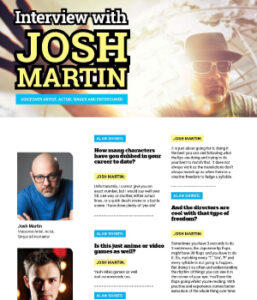
Interview with Josh MartinAnime Voiceover Artist Super Star

With it being one of my favourite genres I am super excited and pleased to be writing this article as conveniently it is also with a dear friend of mine. I first met Josh Martin at an anime convention in Yorkshire many years ago. At the time I was collaborating with my client’s magazine and shared it with him, fortunately, it went down a treat and from there we did a couple of collaborations online with workshops and webinars. Just before the pandemic hit in late 2019 there was another anime convention that Josh was attending and I was supporting the guests. At this convention, I was still working with the Magazine, and this time I thought it would be great fun to do an interview with Josh Martin!

Something I always ask myself when creating content, reaching out to and meeting new clients, and building positive relationships is, ‘How am I adding value?’ in this instance Josh is one of the most prominent anime voiceover artists in the world. This article would add a lot of value to voiceover artists worldwide.

Voicing Thousands of Characters

Having worked in anime myself, I understand the need to diversify the number of characters a voiceover actor needs in this genre. Typically, a session will range from 2 to 4 hours, and it isn’t uncommon for the actor to have to do fodder too. What is Fodder? Fodder is the one-off line here and there that appears throughout an episode. Imagine a huge fight scene with loads of spectators, a fodder line might come from a random crowd member saying something like ‘wow, that  looked like it hurt!’

It is not time- or cost-effective to hire a sole voiceover artist to do this one single line so typically booked voice actors within the cast will share all the fodder lines amongst each other. Josh has voiced A LOT of significant characters, but he is remarkably familiar with spending ten minutes at the end of the session going on a range of random fodder lines too. It is vital for an anime voiceover artist to be able to jump in and out of these characters quickly and with ease.

A Voice Actor Doing a Bit of Everything

Between our branding, social media, website, and networking, it feels a bit busy right? Oh, and that is only the tip of the iceberg, right? Josh works in video games and commercials as well as anime. Still, the thing is, anime requires a triangular skillset that requires the performer to watch the animation, follow the rhythm band, read the text AND deliver a performance at the same time. I refer to it as triangular because they will visually see the lines, the animation with the lip syncs, and the rhythm band. It’s worth noting at this point that not all companies use a rhythm band, many of them will use the three-beeps technique. The reason I am referencing both is that typically for on-screen dubbing, it is the rythmo band typically used, and in dubbing, it is the three beeps. But listening to them as well as performing and fitting the words into the mouth of the character is a fundamental skill to acquire!

Agents in Anime

I find typically across the board that voiceover agents are constantly in demand. Be it for video games, narration, anime, or commercials, everyone wants an agent. The thing is agents are vitally important! They have a trusted reputation with a vast list of clients and typically have better quality and higher paying roles than that of a pay-to-play website or what Google might give you. Typically speaking an agent is required to book stuff in anime, it isn’t essential mind you, but it will massively help you. I booked an anime role through a long string of networking, but the easiest way into anime is via the agents. The thing is, as a voiceover artist, you should have an agent anyway. It is a fundamental step to moving forward with your career and establishing a strong place and reputation for yourself in the industry.

Top Tips From the Interview with Josh Martin

My first tip is to make sure you know what tech you need. Neumann TLM 103 and Neumann U87 are massively popular in anime. The Sennheiser 416 is also another popular microphone. I am not saying ‘buy an expensive mic, and you’ll book work’ but what I am saying is the production companies are used to a particular sound, and they have trust in those products. I want to record on equipment that they are used to, it is what they use in their studios, so I want to be parallel with that standard. My next tip is to make sure you are keeping it fresh; always be thinking and making notes of new characters. I frequently record snippets of cool voices I might fall into, or I’ll make a note of interesting voices I hear whilst out and about.

The next top tip is to network! Make friends with everyone! I met Josh via a friend, Josh and I have introduced each other to a range of people, and we have both made work through our networking. Next, watch anime! You will learn a lot about the style, the character archetypes, the vocal and physical expectations, and the concepts. Anime is typically the age-old battle of good vs evil, and good often wins, but in a format where there is little to no hope.  That last shred of hope often comes off good and they win.

Finally, begin practising the emotions and the intensity levels now, do not wait to get the auditions. Practise now so you are ready for the auditions. As a British actor and voiceover artist, I once questioned if my accent was a good fit for anime, but the truth is all accents are a good fit for anime. Ok, in English, typically, it is the American neutral accent, but I have seen Australian, Russian, British, and African accents in anime. I have performed in an anime with my own accent, I have ‘poshed’ it up a bit too, and I have just made some sounds and emotes too. Anime really is the voice actors’ space to go wild and have fun.
Filed Under: Anime, Interviews

Working with a Voice Over Agency – The Full Story

January 27, 2023 by Alan Shires

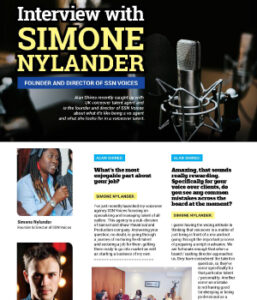
Interview weith Simone NylanderThe Relationship Between an Artist and Their Agent

The relationship between an actor and their agent is a business one. Though a friendship may start and a relationship may deepen, the fundamental core of the working relationship is that of a business relationship. This misconception, particularly with newer actors and voiceover artists, is that a voice over agency will do all the work. The voiceover artist can not just sit at home all day waiting for the phone to ring. The agent will hustle work, but it is vital for the performer to ensure that:

  1. Headshots are up to date and reflect their casting bracket
  2. Demos and reels are up to date, reflecting their skill and range
  3. Availabilities are recorded appropriately for the agent to manage

Voiceover Workshops and Networking

In 2019 at an in-person event called Above and BeVOND, I had the joy of hanging out with Simone Nylander, the owner and founder of SSN Voices (though, at this point, she had not started the agency). I attended Simone’s workshop at this particular event, and I remember the attention to detail. Here is the thing: plenty of people out there can host and deliver workshops, so who do you go with? My angle is that I need to learn from the people who are dealing with the work; an actor booking the jobs I want, a casting director sending out the briefs for the roles I want, and the agents who are channeling those briefs are all great coach suggestions for me. Simone was exceptionally complimentary of my demo, which was reaffirming, and in her workshop, she gave me several good leads based on my style. From that, a friendship was born, and the article was born.

Actors, Voice Over Agency, and Interviews

There are so many fantastic resources and pieces of literature out there, and The Buzz Magazine is one I have had the joy of writing and interviewing for several times. In this instance, having an agent present in the magazine for voiceover artists to learn from was a great collaboration. As an artist, and in this instance also an interviewer, I internally asked myself, ‘what do I want to know?’ and ‘how can I add value to the audience here?’. I figured the information that would help me would help everyone. You can read the full article attached to this blog. However, the two talking points are trends and booking the job.

What Are the Trends in Voiceover?

The best trend example takes us to the commercial world as this gives the most noticeable change in the last decade. We remember the significant characters in the “BUY NOW! BUY NOW!” commercials. Some companies have a long-standing niche or something fresh to bring to the table and still adapt this style. But over the years, it has become a style used less and less. What replaced it was what is known as the ‘conversational read.’ The conversational read is supposed to be the ‘natural read.’ Its purpose is to give the element of honesty, relatability, and truthfulness. The best tip for nailing that read is to imagine who you are talking to and offer a feed-in line such as ‘hey, mom.’ Those elements just help set the tone, a natural tone.

Booking the Job!

It’s one of the heart-breaking elements of this industry. We see a brief that looks amazing, we get put forward and never hear anything again. No feedback, no audition, nothing. What can we do to ensure we at least get an audition? Well, make sure your experience is relevant to the applied role. Ensure your headshots are up to date and you look at the part for which you are auditioning. Make sure your demos and reels are up to date, and you demonstrate the skills needed for the desired job. Then finally, do not forget to constantly keep networking – it’s all about making friends, guys!

So, what happens when you get an audition? You may end up self-taping, making sure you are clear visually and audibly. Get a decent screen that you can crop and cut nicely. But more importantly, deliver a performance parallel with what the brief asks for. Make sure, more than anything else, that you are ‘acting.’ Make sure you give your best performance with a genuine delivery accurate to the brief.

So, what happens if you get called to an in-person audition? Well, much of the above remains to be true. Regardless of whether it is to a camera phone or a 10k + film set camera, you are still performing for a casting director to book the job. Be genuine, do what you must, and give your best performance.

Tips for Voiceover Talent

Make a mistake on the script? Do not go “URGH!” and start again. Instead, take a moment, and continue from where you left off. The same is valid with stutters and blips. However, make an error on your self-tape. Re-record it. Do not send something you do not think is terrific and totally finished. If you are auditioning in person or even online, you do not have the privilege of re-recording but in this instance, if you do, utilise it. Be friendly, and do not bring your bad hair day to the audition; no one likes a grump! Remember to stay in touch with the people you meet and audition for; next time, they might remember you or think you are a fit for something else.

Filed Under: Interviews

Jessica Jefferies Interview: Its Virtually Possible – The Full Story

January 25, 2023 by Alan Shires

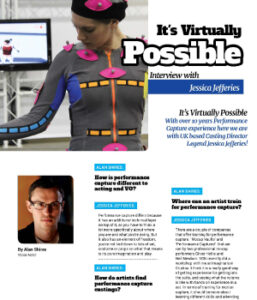
Its Virtually PossibleIt All Started with Jessica Jefferies

This was an area of the industry I discovered in my mid-twenties and prior to that, I was oblivious to it. Backing up a bit, in the last two decades mocap has really come into its own but certainly, in the last ten years from a performer’s perspective, this area has exploded. When I discovered it, I fell instantly in love because I felt that my theatrical training had a place outside of the theatres and in a filming studio-type environment. You can read multiple blogs and interviews I have done on performance capture and motion capture but this Jessica Jefferies interview is where it all started.

Revisiting the Drawing Board as an Artist

When I carried out this interview, it was on the back of a weekend event in London called Get Your Game On. Jessica was running an intensive course which I knew I must attend. This is where my mocap and performance capture journey began, and I have not looked back. The beauty was I did not need to think all that hard about what to ask Jessica for the article because I was too hungry to know as much as I could about working in mocap and performance capture that I was not short of questions. I knew adding mocap and performance capture to my belt was essential but in addition to that I was starting all over again in a new field, looking at the drawing board whilst I learn and develop in this area.

Knowing Who’s Who

Breaking out of our specific fields of work (In this instance voice over) can be tricky. There is so much going on how do we add more to the pile? I soon learnt that the setup was the same in that clients went to casting directors who became gatekeepers of the work. Jessica Jefferies spoke at this particular event, and I was volunteering, so I got to chat with her a fair bit. What makes her position as a casting director unique is that she had worked as a performer in mocap and performance capture for years but wanted to now help more talent get into the industry and help companies draw in a better yield of talent for their projects. At this point, there was not even an agent in the UK specifically for performance capture (There is now). There is only a small number of casting directors in the UK that specialise in mocap and performance capture specifically it’s common for the larger acting agencies to represent artists who are going into performance capture and mocap.

Three Things the Jessica Jefferies Interview Showed Me

Jessica said some very interesting things in the interview, but one of my highlights is her three top tips for actors and voiceover artists to adapt. Those three things are imagination, taking direction quickly, and breathing. I will use the rest of this blog to break down each of these three points they are all massively important in their own right, and I see them as a critical force to success in performance capture and mocap. Remember, I am coming at this from an actor and voiceover artist perspective, not an established regularly working performance and motion capture performer perspective.

Using Imagination

Whether it be on stage, in front of a lens, or behind the mic, imagination is key! Be you carrying out an acting gig or a voice over job, you must use your imagination as it is vital across the entire industry. I often ask my students to tell me what just happened in the scene they are reading from before the first line, they have to make it up! I ask them to describe the situation their character is performing in. The detail is vital, the smell, the temperature, what’s on the walls, how loud it is outside, and anything else they can imagine. We want to get to a place as a performer where we are totally submerged into the imagined environment we have made to deliver a truthful, fresh, and unique performance that will catch the casting directors’ eyes.

Taking Direction Quickly

We know we need to take direction; it’s a massive part of the job. Sculpting our performance around the words given by casting hopes to produce a performance that reflects the characteristics displayed only in their mind. It can be a bit of guesswork, but the key thing here is the word quickly. We have to adapt our performance by implementing their feedback quickly. Why is this? Well, casting professionals often see hundreds of actors, and the first thing is they don’t have time to spoon-feed actors they need the finished package. The second reason is that adapting quickly shows them you can react fast on set and will be able to pull off what is asked of them when it comes to direction.

Adapting Differently to Breathing

It took me years to realise the importance of breath in performance capture and motion capture. As a performer, we know the importance of breathing! In voice over it gets tidied up a lot in the edit, and on-screen, it’s fairly subtle. In performance and motion capture, you have to breathe big! In these skin-tight suits, the censors will pick up every little movement, and the bigger the breaths, the better the digitalized character looks. Also, the breath is a character’s signature! A military officer running will have big breaths but thinks about a dragon; how does a dragon breathe? Well, these are elements we must bring into performance capture auditions.

Filed Under: Interviews, Mocap

Voiceover Software Press – The Full Story

January 22, 2023 by Alan Shires

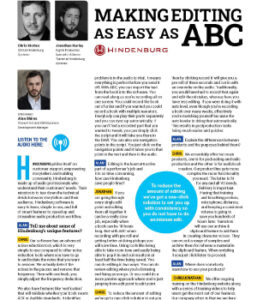
Making-editing as easy as AbcVoiceover Artists and Their Software

It is no secret that voiceover artists are not a fan of technology. That is not always the case, but it is a regular event. I, for one, love technology, I think it’s fantastic and really enjoy it! With that said, it is no surprise that I interviewed the team over at Hindenburg which is a DAW company that pioneered voiceover software, making recording easier for beginners and professionals.

Why I Love Hindenburg

As a voice actor, I think having the most straightforward solutions available is vital. Between marketing, performing, and all those other plates which desperately need spinning, I need something which isn’t going to absorb all my time. Hindenburg serves that purpose! They host a range of intuitive programs which serve voiceover artists in a range of ways. Now on a personal level, taking the voiceover hat off for a moment, I adore innovative technology. I love new smart functionality like audio command programs turning my lights on, right through to the new camera on the latest iPhone. So, to explain why I love Hindenburg so much, I need to unpack this intuitive element a bit more.

Intuitive Voiceover Software is Smart Tech

I first saw the power of Hindenburg on a webinar where they showed me something which changed everything! There are a few things so let us go through them. Hindenburg Narrator has a function that will automatically upload a script to the DAW so artists can read the script whilst following their audio bar in the DAW recording. But wait! It gets better… as a voiceover artist/voice actor, stopping and starting is so annoying! So, Narrator has taken this into account. Let’s use an example; say I record for a solid hour, and I have made three mistakes, Hindenburg allows me to make a note of where the mistake is, and I can simply click on the script where the mistake was. It intuitively will take me to that exact location in the audio. Voiceover artists/voice actors need not ever worry about going through hours upon hours of audio ever again because Hindenburg does it for us!

Fun Additions for Everyday Use

I promised multiple examples, so this next one hits close to home! As a podcast host, voiceover artist, teacher, presenter, and coach, consistency is key! I celebrate having a fantastic home studio with all the best gear, but the recording software is the icing on the cake and needs to look and sound amazing. Often as a performer, especially when being a bit more animated, controlling the gain can be such a drag! One second, I am loud the next I am quiet, and mic technique and gaining control can only do so much. As an actor, I do not want to focus on the technical when I fully flow with my performance. Hindenburg will take the levels and set them all to that same point! How amazing is that? Loud elements are reduced, and quieter elements are amplified. This delivers a consistent, clear, and powerful recording, something every voiceover artist needs.

Voiceover Software and Pesky Plugins

Plugins are often warned against unless you really know what you are doing. But what does that even mean? Plugins are supposed to make things easier, so why fear them? There are dozens of audio recording software plugins out there, and we should be utilizing them, not fearing them! So, let us talk plugins! Noise reduction is a plugin that isolates any unwanted background noise and removes it across the entire audio file. Every voice actor dreams, right? Wrong! The identification of the unwanted audio and the application process can be daunting if you are not confident with software, but in comes Hindenburg! Hindenburg will automatically do this for you! No buttons are required; it’s custom and built into their software, making life that little bit easier!

Voiceover of Today Yesterday

In the good old days, voiceover artists did not need a home studio or recording software. Crazy right? Well, the industry years ago was much smaller and enclosed. Most voice artists would be summoned to a studio where the sound engineer would look after all the equipment and recording. Often the director would be present or on the line; though that still happens, many artists now record from home. Typically, an actor would only be summoned into the studio for more prominent clients and better-paid jobs in the latter days.

So, what happens instead? Voiceover artists build their own home studios. There are countless ways to ensure someone gets a decent-sounding environment. Of course, the better the setup and the bigger the budget, the better the quality in the right hands. But often, people who rent or travel a lot will also have portable solutions at their disposal! Savvy artists will use their equipment and maximise functionality to get world-class standard audio quality. So aside from the booth itself, whether built, purchased, or portable, all voice actors need an audio interface and a microphone.

More About Good Equipment

Typically, we would be expected to record on a large diaphragm condenser microphone, and though this is not always the case, it is the norm. The expectation would be that the polar pattern records in cardioid; aside from that, you are left to your own devices. Standard accessories like a pop filter, stand, and XLR cable are essential whatever setup you have; of course, closed-ear headphones are also required. Why closed ear, you ask? Simply put, if sound escapes the headphones, the microphone will pick it up, and you will hear it back on your recording.

Microphones all do the same thing, but some do things more tailored to your unique qualities, and finding the right microphone can be tricky! It is best to seek advice from established voiceover artist and connect with companies with microphones within your budget that you like the look of. It is also worth looking into what microphones your potential clients like. I record on a Neumann TLM 103; why? Because loads of my clients and potential clients want that microphone.

Completing Your Voiceover Setup

Once you are set up, the last thing to do is to select your audio software (DAW). At this point, after investing in all the right kit and working so hard to educate yourself in audio, why would you settle for anything less than the best with your software? We know Hindenburg removes any unwanted sound, fixes the levels, AND makes long audio easier with its smart intuitive functionality. It is a voiceover artist’s dream.

Filed Under: Home Studio, Interviews

The Mocap Agency – The Full Story

January 20, 2023 by Alan Shires

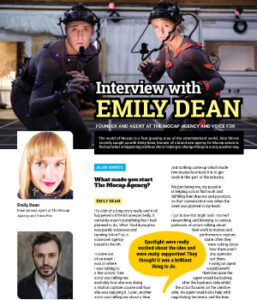
Interview view with EmilyHow the Actor and Voiceover Artist Get in With the Mocap Agency

If you have read any of my other motion capture and performance capture posts, you will know I LOVE this area of the industry, it is one of my favourites and it is one of the most fun areas too! I loved the idea of being represented explicitly for motion capture and performance capture, and from the moment I heard of The Mocap Agency, I wanted to get involved. The Mocap Agency was birthed by Emily Dean, who is also the agent for Voice Fox (my agent). This agency was geared to go in early 2020, and the pandemic happened! But Emily persevered to make it what it is today and boy is it paying off! – As a side note, when unexpected trials happen, such as pandemics, don’t give up! So, how does an actor and voiceover artist get in with The Mocap Agency?

Recognising That it’s All Just Performance

It’s all just performance, guys! It’s all acting! I have a background in theatre, and after trying my best to break into the acting world fresh from my BA Hons in Acting, I soon discovered I had to pull my socks up and learn the industry’s business side. As a business, you are constantly growing and evolving, which is essential too. But to fund, grow and develop my acting business, I discovered voiceover, which fundamentally became my full-time focus and liberated me from a place of being employed to being self-employed. But what about all that great theatrical training? Well, the voiceover skills I built, the acting skills I studied, and the theatrical elements I trained under all set an excellent foundation for good motion capture and performance capture performer.

Dealing With Setbacks

So for me, I happily approached Emily regarding representation in this area, though very much ignorant of what I needed to elevate above the foundation perspective I shared above and propel myself into the competitive circle. Truth be told, there are thousands of actors who had the experience I had, so I had to do something different and showcase a unique element of my skills, almost how other businesses pride themselves on their Unique Selling Point (or USP), I too needed to find my ‘USP’ to showcase.

Finding Opportunities to Work with the Mocap Agency

Fortunately, one of my clients was keen on having The Mocap Agency featured in their magazine, and as Emily was my agent, I was the one who was able to interview her. As I was interviewing Emily about The Mocap Agency, I learnt very quickly that I needed more tools under my belt. As my voice agent, I could ask Emily for feedback too, but the article was enough for anyone to understand what they needed to get into motion capture. So, what do you need? – well, fundamentally, you need two things to start you off.

The first is training! Take a mocap course, get familiar with a T pose, an A pose, and a tight sweaty suit, and learn the terminology and setup. Ask about how the markers and cameras work. Reading this, do you know what a volume is? And no, I am not referring to the audio levels blasting from your speakers. What about a ROM? (Range of Movement). You will learn these introductory elements from some motion capture training courses. Target 3D in the UK does a phenomenal 2-day introductory course that is second to none. I know the desire is just to act and want to book the prominent characters, but there must be an understanding technically to work in performance capture too. Shoots are so fast, and deadlines are so tight that there isn’t always time to instruct people on the job.

The second thing you need is skills! A skill will give you that nice USP to a potential client. The ability to yield a sword, fire a gun, ride a horse, juggle, move on a unicycle, or just about anything and everything else you can imagine are great skills. If they need this for a performance capture job and you have that ability, you are miles ahead of your competition.

Voice Actors Pioneering in Motion Capture

So, my story is I left that conversation and the interview with Emily, and I realised I needed to gain some skills. I had already taken courses and understood motion capture, but I did not have much in the way of a unique selling point. So, I learnt to fire four guns, wield a staff and a light sabra, and did basic horse riding. I think horse riding needs more work as there are many programs, but the basics are there, and it’s a journey that I enjoy. Like with most things, practising helps to push these things forward progressively and powerfully. With the guns, I run through my mind the routines regularly, but I remember the weight and the recoil, which helps with performance. Finally, for the light saber and staff, this is something I can simply just practise in the garden. But the keyword I just used applies to everything I suggested above; practise. We must keep practising our skills and our craft to stay sharp. Pay to ride a horse for an hour or visit a shooting range, and buy your own props like staffs and swords so you can rehearse and learn routines. Practise! Practise practise practise!

Booking With the Mocap Agency

At the end of this journey, when I had made a performance demo, I was taken on by The Mocap Agency, got my first audition, and booked a job which was a full performance capture role on UK TV. It is important I continue to learn and practise in this area whilst I attempt to hustle roles. But the final thing is we must think about our material. Actors have showreels, and voice actors have demos, but what do mocap actors have? Well, a skills reel for sure, but if you can get mirroring footage of you in the suits performing against the animated characters on the screen, you should! Seeing it will make you up your game, and acquiring the footage shows you have been hustling away in this area. Combining skills and performance together into a demo will produce a strong marketing tool for your business in this field.

Filed Under: Interviews, Mocap

How to Mo’Capture the Job – The Full Story

January 12, 2023 by Alan Shires

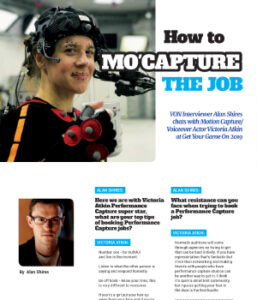
Mo’Capture the JobThe Hustle of Performance Capture

If you have read any of my other mocap or performance capture blogs, you will know by now I am passionate about this area of the industry. Accompanying that passion is the endeavour to ensure that I consistently continue sharpening my craft and learning as much as I can about this field. Any entrepreneur should be looking to become an expert in their field. I think if someone is doing something half-hearted, it really shows, and in entertainment, you do need to give it your everything to book the job otherwise, someone will get it over you. Moreover, if you are down in the dumps when performing, it’s going to set up a poor atmosphere for all involved, so the problem with that is, well… they just won’t book you again, and that is the worst problem you can have in this industry because word spreads fast.

Famous Actor Working in Performance Capture

I met Victoria Atkin at one of my client’s video game events called Get Your Game On, and I loved learning about her journey with Ubisoft, Assassins Creed, and performance capture. Victoria had booked one of the first lead female roles in a video game with her role as Victoria Atkin in the Assassins Creed syndicate. Many actors and voiceover artists work in mocap and performance capture aspire to book these types of roles. Typically, the pay is fantastic, the work is consistent for several months, and you get flown worldwide. It’s an amazing experience.

How Does a Voiceover Artist Book the Biggest of Jobs?

Victoria shared a phenomenal story of where she did a self-tape, sent it over, and then forgot about it. A year later, they booked her for it. Sometimes when we send self-tapes, it can take a while to hear back, so I think the best thing is just to forget about it and move on to the next job. In the meantime, you never know when the return on that audition or self-tape might present itself. We are so used to everything moving a million miles an hour, so it’s pleasantly unique to hear how this works with a massive title like Assassins Creed. The key is to always be ready, be ready to audition and self-tape, be ready to fly, be ready to be called in, and be ready for a call back.

Working with the Great Actors in Performance Capture

Victoria agreed to teach an intensive workshop for the organisation. I think it is essential to work with the people who have booked the jobs you aspire to book, so I signed up for this workshop. It was in 2019, in the early days of my ventures into mocap and performance capture. I am pleased to say I have built fantastic clients and booked excellent jobs since then. The workshop was very informative, and the content available was impressive. Learning from the best brings value because they have the experience of not only the process of booking the job but the knowledge of what it takes to see it through to completion. I used the workshop and the event as an opportunity to interview Victoria and get some powerful content for the readers.

Top Tips From the Best in Mocap

I wanted to know what challenges an actor and voiceover artist may face in mocap and performance capture. Well, the answer to this takes us back to that position we are very familiar with, that being, we are in a heavily over-saturated industry where a lot of the work is hidden behind a small number of agents. So, finding the work is a challenge. Mocap and performance capture is a small-knit community, so networking, building a portfolio, and attempting to be the best you can be is compulsory for success.

The Audition Process

We send in voice demos for a voiceover job and a showreel for the on-screen jobs, but what do we send off for performance capture and mocap roles? Any skills you may have, like parkour and arms usage, must be captured on camera. If you have the footage in the volume against what’s on the screen, then this is good to have (though keep it short), and finally, just deliver something that shows off your skills and unique abilities. What happens after the demo stage? Well, you may be asked to self-tape, and for mocap and performance capture, these range from being random to needing a lot of physical ability.

I have had auditions that required the tape to show a lot of movement in a vast space, I’ve had others that are looking to capture bigger characters with powerful facial expressions and line delivery. The final thing to consider with performance capture and mocap is the prospect of getting called into an audition. Though the world has changed how it deals with the audition process, it is not uncommon to be called in for an audition, even if you have sent demos and self-tapes. Sometimes you might be asked to audition instead of a self-tape, other times, it will be the third step following the demos and the self-tape. Over the years, I have learned to have fun in in-person auditions and try to give something to the casting director that they did not expect but is true to the piece. Don’t worry about what anyone thinks. Give your best performance, and just enjoy the experience. I love chatting with the team during an audition, after all, we are all human, and auditions are great networking and connection-building opportunities.

Filed Under: Interviews, Mocap

  • Page 1
  • Page 2
  • Go to Next Page »

Primary Sidebar

Categories

  • Animation
  • Anime
  • Commercial
  • Corporate
  • Home Studio
  • Interviews
  • Mocap
  • Narration
  • Personal Development
  • Press
  • Reviews
  • Video Games

Archives

©2025 Alan Shires // Voice Over Site by Voice Actor Websites
Website Hosting by UpperLevel Hosting

alan@alanshires.co.uk

MENU
  • Home
  • Voice Demos
    • Animation
    • Anime
    • Commercial
    • Narration
    • Video Games
    • Featured Work
  • Acting Demos
  • About
    • About
    • Resources
    • Testimonials
  • Clients
  • Media
    • Media
    • Press
    • Interviews
    • Reviews
  • Blog
  • Contact